It started with a frustrated sigh on the other end of the line.
The customer had called three times this week. The agent — let’s call her Priya — was trying her best. She toggled through four different systems, trying to find past interactions. The silence was stretching. The customer was losing patience.
That’s when we knew: something had to change.
The Mission
Our team at Infosys — the Cortex team — was tasked with a bold goal: Design a platform that empowers call center agents like Priya to work smarter, faster, and with empathy.
We didn’t just want to create another tool. We wanted to build a co-pilot — something that could understand the agent’s needs in real time, surface the right information, and even sense the customer’s mood to guide the conversation.
But before we could design anything, we had to understand everything.
Into the Call Centers
We began by stepping into their world.
We listened. We sat beside agents during live calls — watching them scramble for data while trying to stay calm and composed.
We asked. We interviewed over 20 stakeholders — agents, supervisors, trainers — to understand their pain points.
We observed. From seasoned agents to rookies, we saw how people adapted to broken systems and built their own hacks.
We surveyed. 100+ responses gave us a broader view of patterns and bottlenecks.
And we started seeing a story form.
The Aha Moments
Here’s what we uncovered:
Fragmented Information = Delayed Help
Agents were wasting valuable seconds switching between CRM, call logs, and product systems. Customers felt it as silence. Agents felt it as stress.
Emotional Blind Spots
Agents told us: “Sometimes I can tell a customer is angry, but other times I can’t read the tone until it’s too late.” They needed something to read between the lines for them.
Time Pressure Is Real
KPIs like AHT (Average Handling Time) created constant tension. “We’re supposed to be fast, but also empathetic — how do we do both?”
Real-time Support = Confidence
Early tests with a prototype that nudged emotional states (like “Customer seems frustrated”) made agents feel more prepared. One even said, “It’s like having a smart teammate next to me.”
Meet the People
We created personas to keep these stories alive in our design process:
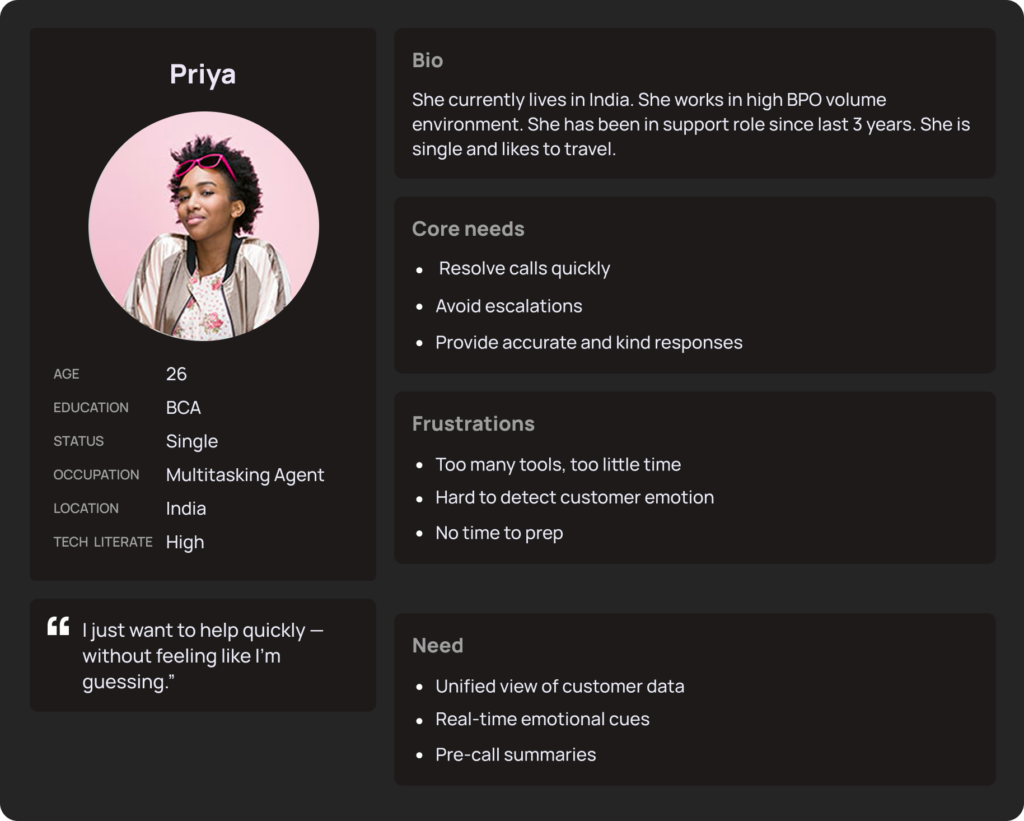
Priya – The Multitasking Agent
Handles 50+ calls daily
Fast with tools, but overwhelmed by disjointed systems
Wants emotional clarity to avoid escalations
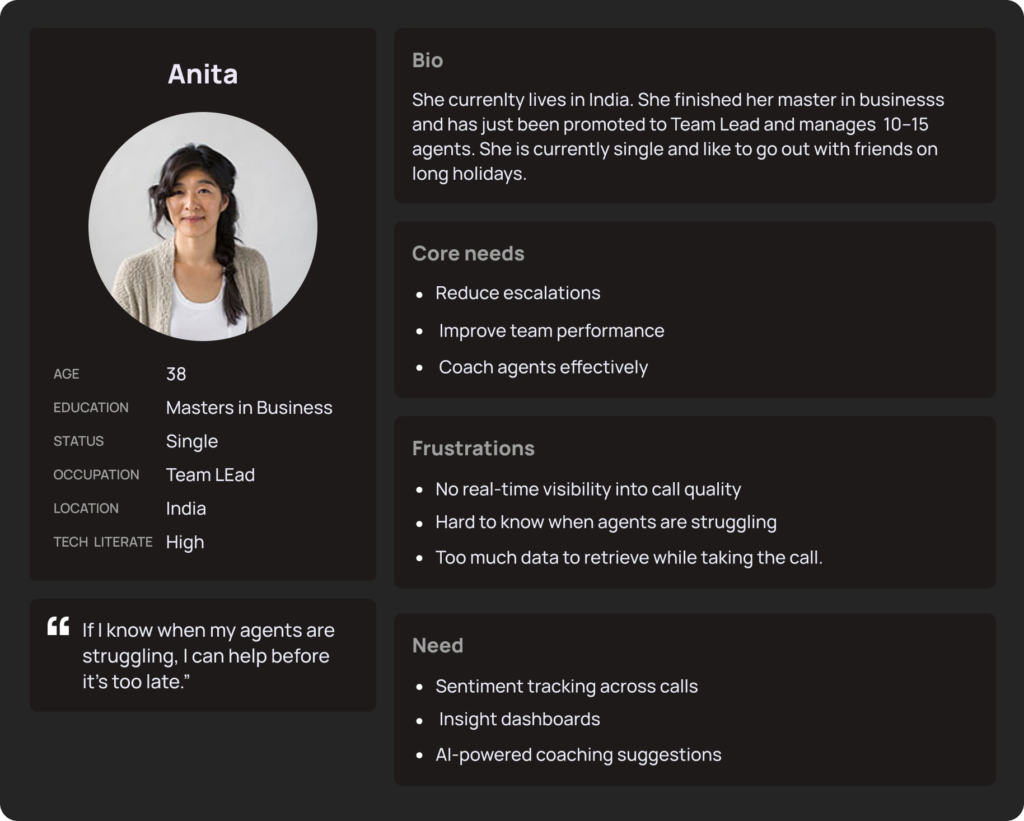
Anita – The Team Lead
Coaches 10 agents
Needs performance visibility and ways to reduce repeat calls
Wants tools that help her team, not just track them
Designing with Purpose
Our research led to key design decisions:
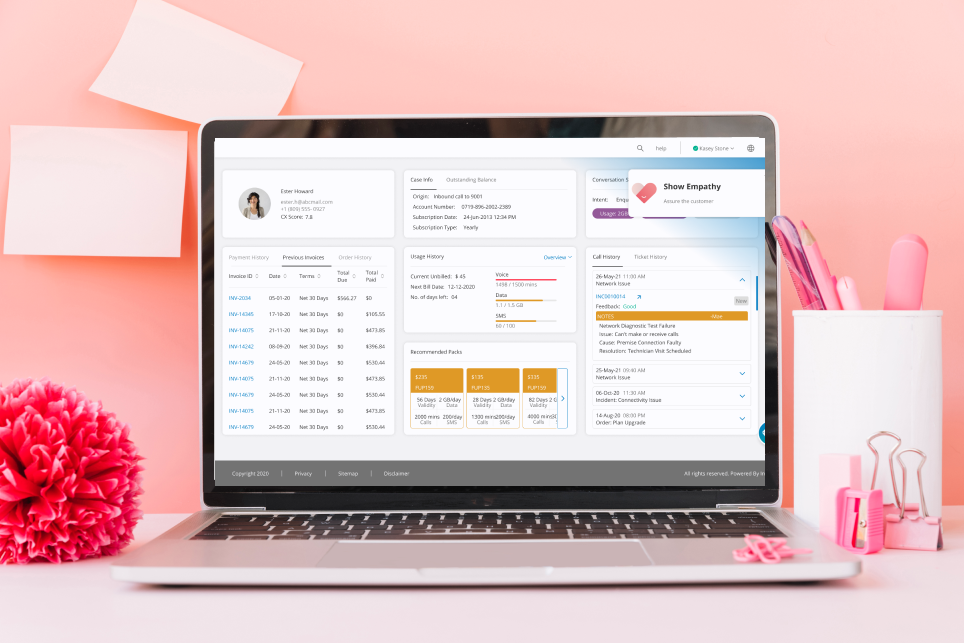
Unified Information: Everything in one place — customer history, previous tickets, and emotional cues.
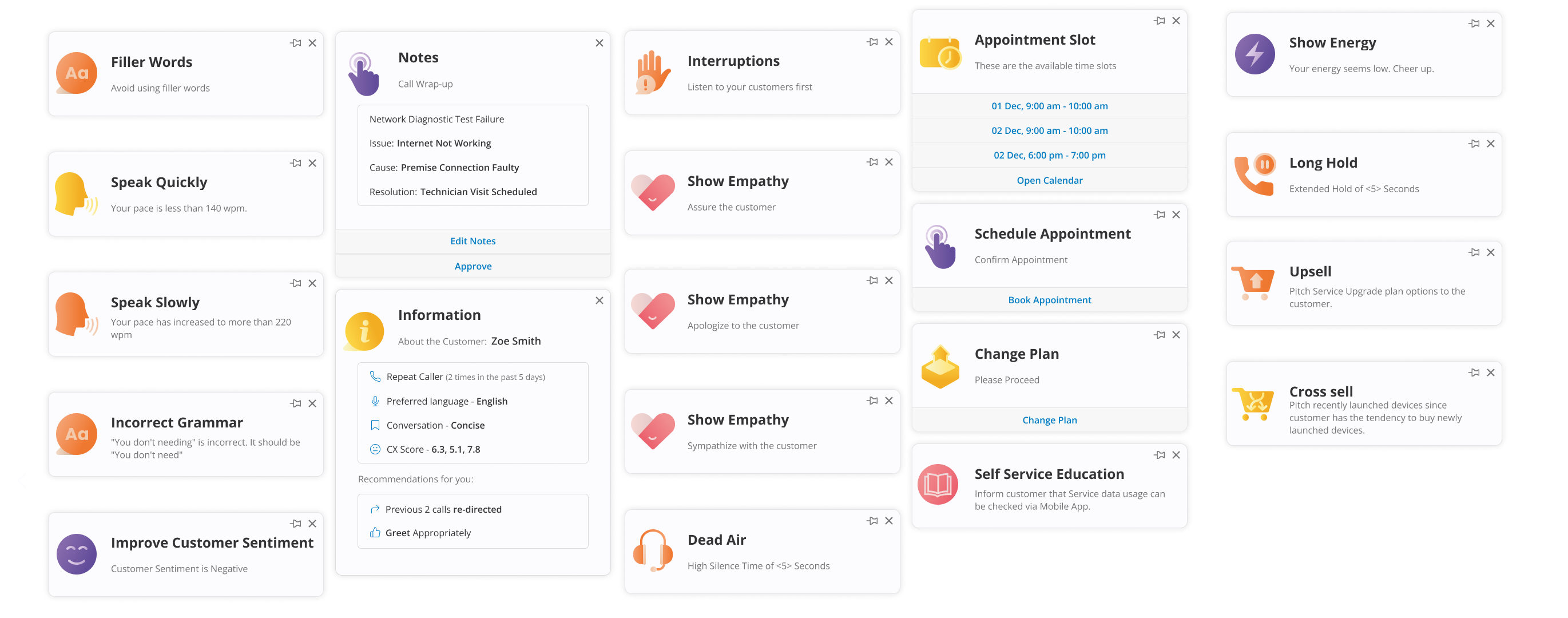
Real-Time Nudges: AI-driven hints to surface tone, sentiment, and urgency.
Call Summary Cards: Auto-generated summaries help agents prep before the call ends.
Post-Call Insights: Feedback loops to improve agent performance over time.
Supervisor Dashboard: To get all the information of the agents and what they are working on.
What We Learned
Designing for call centers isn’t just about speed. It’s about understanding pressure, supporting emotion, and building trust between human and machine.
Our research reminded us: the agent experience is the customer experience. If we empower Priya, we empower every customer she speaks to.
Cortex was never just a product. It was a response — to the sighs, the silences, the missed moments.
Reduced Cognitive Load: By unifying scattered data into a single interface, Cortex helped reduce the number of system switches per call, significantly decreasing agent fatigue and response time.
Improved Call Efficiency: With auto-generated call summaries and AI-powered sentiment cues, agents could handle calls more confidently, leading to shorter average handling times and better first-call resolution rates.
Stronger Agent Confidence: Real-time emotional nudges empowered agents like Priya to adapt their tone mid-call. Agents reported feeling more in control and emotionally supported, particularly during high-stress interactions.
Better Team Insights: Team leads like Anita gained visibility into agent performance and sentiment trends, allowing them to offer more personalized coaching and reduce escalation rates.
Emotional Intelligence at Scale: Cortex became more than just a support tool — it acted as a real-time emotional translator, helping agents build empathy, not just efficiency.
What Makes Cortex Different?
Empathy-First Design: While most platforms focus on automation or speed, Cortex focused on augmenting emotional intelligence — helping agents respond not just quickly, but compassionately.
Co-Pilot, Not Just a Tool: Rather than replacing the agent, Cortex was built as a real-time teammate — quietly nudging, informing, and guiding without overwhelming.
Field-Driven Innovation: Every feature was born from on-the-ground observation and agent interviews — not assumptions. This grounded approach made adoption smoother and the tool more intuitive.
Agent Experience = Customer Experience: Unlike tools that center purely on metrics, Cortex aligned with a deeper truth: when agents feel supported, customers feel heard.
Integrated Emotional Cues: Most AI tools miss context. Cortex didn’t just analyze sentiment post-call — it responded live with visual cues, urgency tags, and tone shifts, giving agents a sixth sense during calls.